
Fire pumps are a core part of any fire extinguishing system and are vital in an emergency. They pressurise water or extinguishing chemicals and deliver them to the fire zone, so response can be fast and effective. Pumps should therefore be designed to NFPA 20 and carry approvals such as UL/FM.
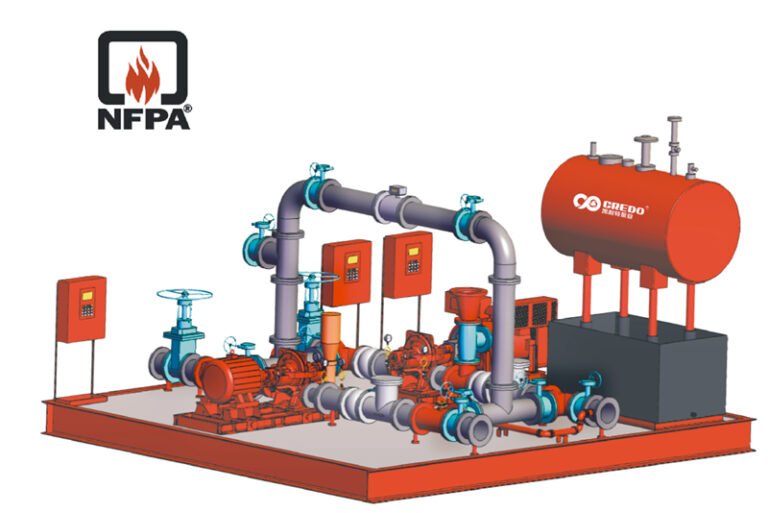
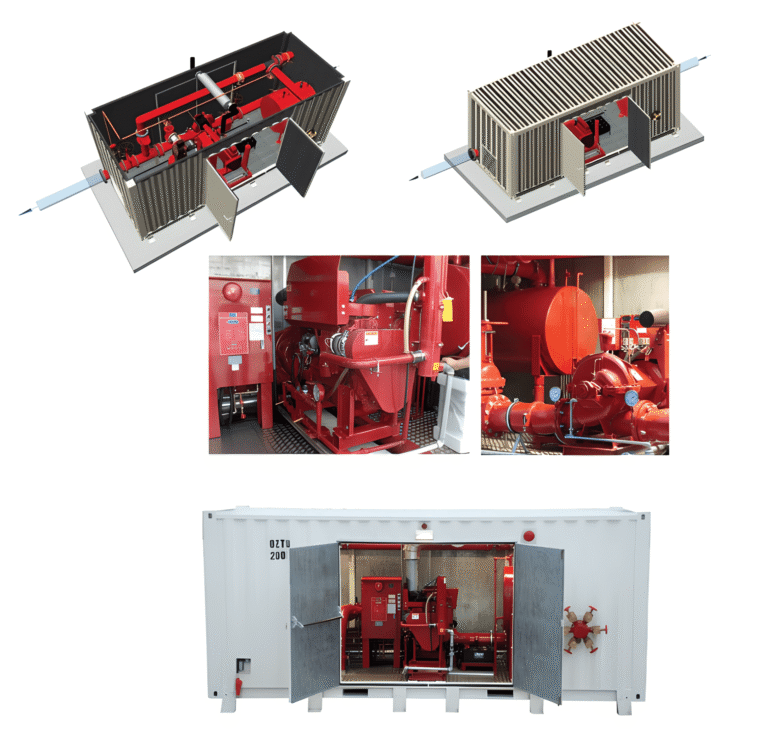
There are two main types: diesel engine driven and electric motor driven. Ready-made containerized packages are also available. Pumps are available to ISO, CE, UL and FM Global requirements, with flows from 25 gpm to 8000 gpm (95 – 48465 dm³/min) and pressures from 37 psi to 641 psi (77 – 4420 kPa). Standards followed: NFPA 20, UL, FM, VdS, LPC, EN 12845.
Driver types
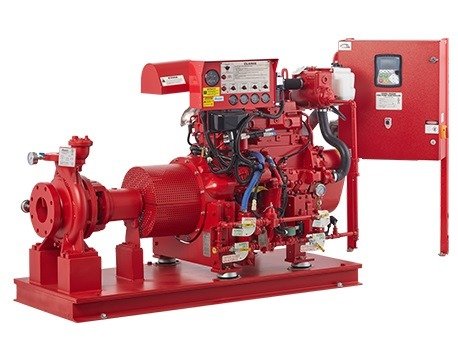
Diesel engine driven fire pumps run on diesel engines so they keep working even when the power fails. They are widely used where the electrical supply is weak or unreliable, as a backup or as main and backup, and in industrial sites that need high flows where electricity is a problem.
Diesel engines are FM-approved fire pump drivers for sites that need an internal combustion drive. The rated horsepower is the power available to the pump under NFPA standard installation conditions (91 m above sea level and 25 °C). The engine chosen must have a rating at least equal to the maximum power the pump needs.
Liquid-cooled diesel engines use raw water from the fire pump, through a heat exchanger, to cool the engine's primary coolant.
Right-angle gear drives transmit power from horizontal engine shafts to vertical pumps. Most vertical-shaft fire pumps made today are rated at about 1760 rpm. Combustion engines are FM-approved for about 1750 – 3200 rpm, so reduction ratios and 1:1 gear ratios are generally used. The gear must have an available power rating equal to or higher than the pump's maximum power requirement.
Electric motor driven fire pumps are usually cheaper and easier to maintain, and are preferred in buildings where noise is a problem, such as hospitals, hotels and residences. They need a stable power source and are generally used in city areas and smaller facilities. When both main and standby pumps are electric, an automatic transfer switch is needed for automatic supply changeover.
Fire pump types
- Horizontal split case: widely used in large industrial plants and commercial buildings. The casing splits in two along the shaft centre line, which makes it easy to use and repair. Suitable for fire protection service where water can be supplied under positive pressure.
- End suction: a "back pull-out" design driven through a spacer coupling, so the rotating assembly of an installed pump can be replaced without disturbing the suction and discharge piping or the driver. The suction connection is horizontal, opposite the driver, and the discharge is vertical at the centre.
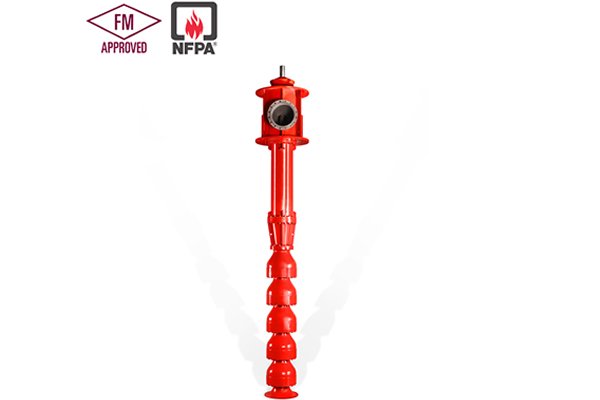
- Vertical turbine (long shaft): FM-approved for drawing water from lakes, rivers, open pits, bored wells and other underground sources, and preferred where space is limited. Each pump has a discharge head, motor stand, column pipe, line shaft, bowl assembly and suction strainer. The column pipe length must be specified when ordering.
- In-line: the manufacturer's vertical electric motor mounts directly on the pump, and the suction and discharge nozzles share a horizontal centre line at 90° to the motor shaft. It is mounted on the pipeline, so access is easy.
- Jockey (pressure maintenance) pump: a small pump connected to the fire system near the fire pump. It makes up slow pressure losses from temperature changes, trapped air or tiny leaks, and keeps system pressure steady. It is sized for less flow than one sprinkler: about 3% of the main fire pump flow, at a pressure 10 psi higher than the main pump.
Fire pump controller
See our dedicated page on fire pump controllers (electric, diesel and jockey, Tornatech) for types and selection.
Controllers run the pump automatically so it can respond quickly in a fire.
- Standard enclosure: NEMA/UL Type 2
- Ambient operating range: 4 °C to 50 °C (optionally 4 °C to 55 °C)
- Starting methods: across-the-line, part winding, wye-delta open transition, wye-delta closed transition, autotransformer, digital solid-state soft start, automatic transfer switch
- Special enclosures: NEMA Type 3RE, Type 4, Type 4X (#304 stainless, #304 painted steel, #316 stainless, #316 brushed stainless, #316 painted steel), Type 12
- Automatic power transfer switches: generator set emergency supply, generator set with bypass isolation, second utility emergency supply, second utility with bypass isolation
- Pressure transducers: 0–500 psi (fresh water), 0–300 psi (corrosive service), 0–500 psi (corrosion resistant); 240 V enclosure heaters (with thermostat or humidistat)
Special fabricated fire pump station (plug and play)
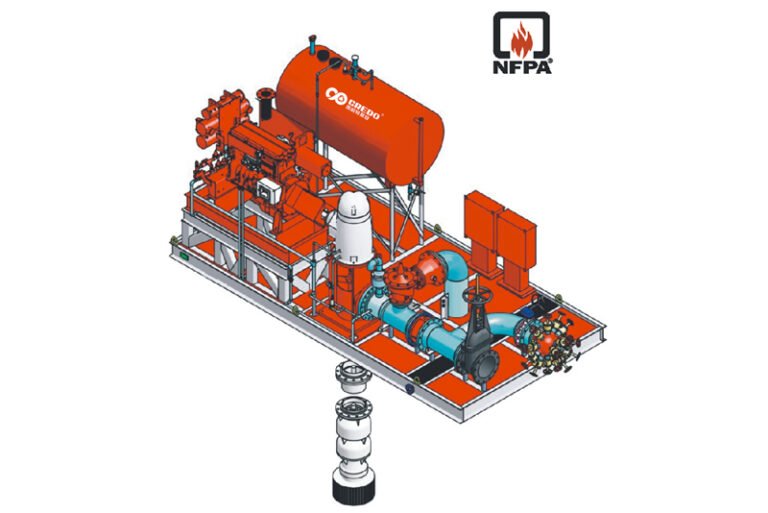
Containerized fire pumps suit situations that need portability and fast installation. They are housed in a container, used by emergency response teams or on temporary construction sites, and are easy to move and commission.
Skid-mounted fire pumps are fully NFPA 20-compliant, pre-packaged solutions that combine pumps, drivers, controllers and piping on one structural skid. They simplify installation, reduce site labour and speed up project delivery.
- NFPA 20 compliant: meets international fire protection standards.
- Pre-packaged and factory assembled: plug-and-play installation.
- Flexible configuration: with or without a protective enclosure, customised to the project.
- Compact and modular: saves floor space, simplifies logistics and speeds up commissioning.
- Less site labour: minimises installation time and cost.
- Custom sizes: can be built to fit the pump room or container.
Flow meter: fire pump flow meters are used to determine pump flow. Water from the pump is temporarily routed through the meter and returned to atmospheric drain or the water source. Meters are calibrated to read flow directly in gpm (dm³/min); a control valve in the line must be fully closed when the meter is not in use. Unless stated otherwise, the rated working pressure is 175 psi (1205 kPa).
Before ordering a pump
Consult on size, driver type, suction sources and location before ordering a fire pump. Plans showing the location and pipe connections should be submitted to the authorities for review before the order is placed. The manufacturer must be given complete data, including rated capacity, net head and suction lift. The pump manufacturer is responsible for supplying a complete unit of pump, driver and required accessories to the standards, and performance should be guaranteed in the field test after installation. A new installation cannot be accepted until it has passed a satisfactory field acceptance test by FM. The exact horsepower requirement of each pump should be set by a shop test on the pump.
FM-approved pumps are not recommended for installations where suction is normally under lift, but they are tested for satisfactory operation under negative suction conditions of up to 5 m (15 ft) at 150% of rated capacity.
IoT in fire protection
- Better safety: IoT systems detect fire hazards faster and more accurately than conventional systems, and response is coordinated faster.
- Lower operating cost: predictive maintenance needs an up-front investment but prevents costly failures, and better accuracy limits false alarms.
- Better data analytics: continuous monitoring produces data that can be analysed for risk assessment and long-term safety planning.
Smart fire pump monitoring
Advanced sensors, controllers and communication modules allow real-time remote monitoring and control of critical pump parameters. These include suction and discharge pressure, pump run/stop status, flow, power use, battery health (for diesel engines), controller status and weekly automatic test compliance.
- More uptime: early fault detection and instant alerts.
- Compliance: automatic data logging supports NFPA 20 and local standards.
- Remote access: engineers and safety managers can watch systems from anywhere.
- Savings: less downtime and easier maintenance.
Tekno Fire pump controllers comply with NFPA 20, UL and FM and come with built-in remote monitoring, automatic test scheduling and detailed fault diagnostics. Optional IoT gateways connect pump systems to cloud platforms or secure networks, and digital dashboards give access to performance data from a desktop or mobile device.