
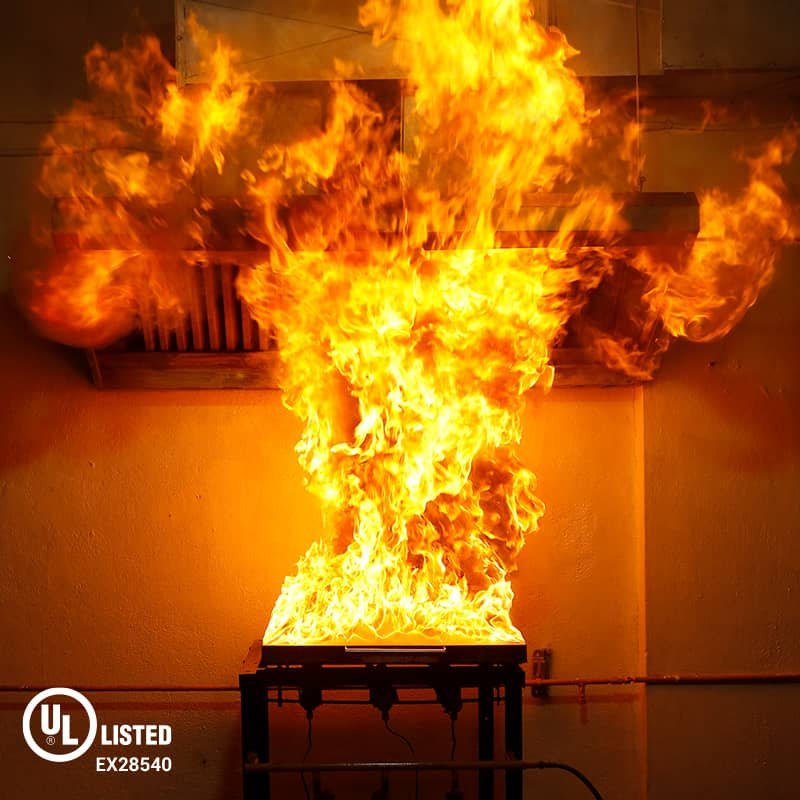
Modern commercial kitchens run around the clock and cook and fry at the same time, so the fire risk is high. Hot cooking oils and deep fryers in particular are a serious hazard. A kitchen fire suppression system is a basic safety measure for restaurants, food trucks, hospitals and modern kitchens. Tekno Yangın supplies, installs and services UL and LPCB listed wet chemical systems that protect the hood, duct and appliances.
What is a kitchen fire suppression system?
It is a purpose-built system that detects and puts out fires in commercial kitchens quickly. It combines detection, an automatic discharge mechanism and a specially formulated extinguishing agent. When a fire is detected, the agent is directed straight at the source, flames are put out fast and re-ignition is prevented.
How it works
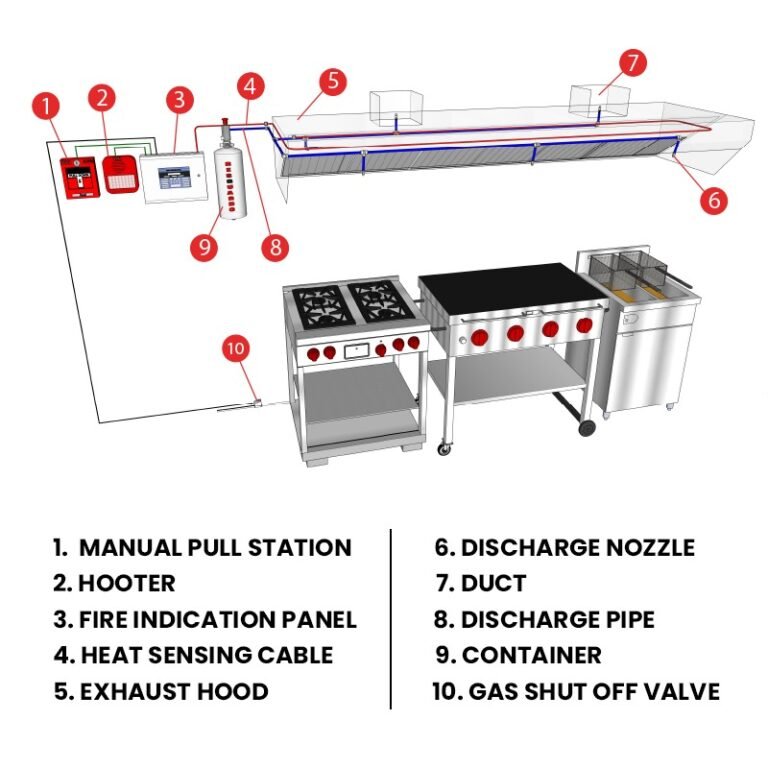
- Detection: fusible links in the hood and duct melt at a set temperature (mechanical systems), or linear heat detection cable or probe detectors signal a control panel (electric systems).
- Release: the container valve opens automatically. The system can also be released by hand from a pull station.
- Discharge: a low-pH wet chemical agent flows through fixed nozzles over the appliances, the plenum and the duct. On burning oil it forms a soapy layer that seals the surface while the water cools it, which stops re-ignition.
- Shut-off: the gas supply is closed and electric power to the appliances can be cut, so the fuel source stops feeding the fire.
- Alarm: the discharge can be signalled to the building fire alarm panel.
What it protects
- Hood, plenum and grease filters
- Exhaust duct and chimney
- Fryers, griddles, ranges, woks, salamander and chain broilers
- Charcoal and wood-fired grills
System components
- Wet chemical agent container (stainless steel or epoxy-coated)
- Nozzles: wide-angle for plenum and duct, narrow-angle for appliances
- Mechanical detection (fusible links) or electric detection (linear heat detection cable, probe detectors) with control panel and solenoid valve
- Manual pull station
- Automatic gas shut-off valve and, where needed, electric shut-off
- Pressure gauge and pressure switch
- Gas detection and alarm integration (optional)
Standards and approvals
Kitchen systems are tested and listed to UL 300 and, in Europe, EN 16282-7. NFPA 17A covers wet chemical systems and NFPA 96 covers kitchen ventilation and duct cleaning. UL and LPCB listed systems are available. Approvals apply to specific products, so we confirm them for the system in your offer.
Where it is used
- Restaurants and fast food chains
- Chinese restaurants (wok and high-flame kitchens)
- Food trucks and mobile kitchens
- Hotel, hospital and staff canteen kitchens
- Shopping centre food courts
- Food factories and catering facilities
- Modern and cloud kitchens
Why it matters
- Immediate response: kitchen and hood fires can spread quickly through the duct. The system limits damage and supports life safety.
- Less downtime: the fire is brought under control quickly, so the business is closed for less time.
- Protection of people and property: including mobile kitchens such as food trucks.
- Business continuity: a reliable system keeps disruption to a minimum.
Our process
Kitchen survey and appliance list, system design and drawings, supply, installation, commissioning test, staff briefing, and a maintenance contract with the six-monthly inspection.
Contact us for advice on the right system for your kitchen. Related: gas extinguishing systems, fire detection and alarm systems.
Frequently asked questions
What is the difference between wet chemical and dry chemical in kitchens?
Modern kitchen systems use a wet chemical agent, a water-based potassium solution. On hot cooking oil it reacts to form a soapy layer (saponification) that seals the surface, and the water cools it, which prevents re-ignition. Dry chemical does not cool the oil as well.
Which standards apply?
Kitchen systems are tested and listed to UL 300 and, in Europe, EN 16282-7. NFPA 17A covers installation and maintenance of wet chemical systems, and NFPA 96 covers ventilation and duct cleaning. Systems with LPCB or UL listing are available.
What does the system protect?
The hood, the plenum and filters, the exhaust duct, and the cooking appliances underneath: fryers, griddles, ranges, woks, broilers and charcoal grills. Each appliance gets its own nozzle, selected for that appliance.
What happens when it discharges?
The agent is released through fixed nozzles. At the same time the gas supply is shut off and electric power to the appliances can be cut. The system can also be released by hand from a pull station near the exit.
How often is it serviced?
NFPA 17A calls for inspection at least every six months. Fusible links are replaced as needed, and the hood and duct must be cleaned regularly under NFPA 96.
Do I need a gas detector too?
Gas detection with automatic gas shut-off is a common addition for kitchens that cook with gas, and is often required by the building's fire safety design. Ask us to include it in the offer.