Gas extinguishing systems are preferred where dry chemical, water or foam systems could damage the equipment in the protected area, or where the suppression time has to be short. FM200, CO2, Novec 1230 or inert gases can be used.
System types
- Inert gas extinguishing
- CO2 extinguishing
- FE-13 extinguishing
- FM-200 extinguishing
- Novec 1230
- Water mist
FM200 gas systems
FM200 came into use to replace Halon. It is an environmentally friendly gas with a short atmospheric life. It does not harm the ozone layer (ODP 0), and it is colourless and odourless.
FM200 is not electrically conductive or corrosive and leaves no residue after a fire, so it is preferred for areas with sensitive equipment. It has a strong extinguishing effect at low concentration, and it can be used safely where people are present, even at the highest extinguishing concentration. It is effective on Class A surface fires, Class B flammable liquid fires and Class C electrical equipment fires. Its compression ratio is high compared with other gases, so fewer cylinders and less space are needed.
Typical uses: IT and data centres, archives, museums, medical equipment rooms, stores, libraries and historic buildings.
CO2 gas systems
CO2 is about 50% denser than air, colourless, odourless and electrically non-conductive, and it is stored as a liquid in high-pressure cylinders. Its use has declined as Halon systems were phased out, but low filling cost keeps it a common choice for protecting unoccupied spaces. For these applications, breathing apparatus and emergency lighting are essential.
Novec 1230 gas systems
Novec 1230 is 3M's clear, colourless fire protection fluid with a low odour. When discharged it vaporises immediately, absorbs heat and fills the protected volume. Unlike other halocarbon Halon alternatives, it does not deplete ozone (ODP 0) and has a very low global warming potential (GWP < 1).
It suits special hazard areas where people are present, where a non-conductive medium is needed, where electronic systems cannot be shut down automatically in an emergency, or where cleaning up residue is a problem.
Applications: aviation facilities, commercial and marine vessels, computer and electronic control rooms, critical military systems and data processing centres.
Inert gas systems
Gaseous fire suppression is also called clean agent fire suppression: inert gases and chemical agents are used to put the fire out. In the US these systems are governed by NFPA 2001; other countries have their own standards and regulations.
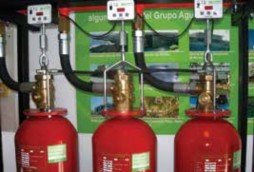
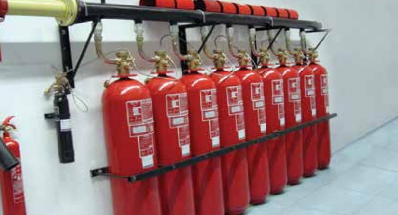
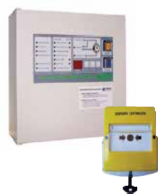
A system usually consists of: the extinguishing agent, agent storage containers, discharge valves, fire detectors, a fire detection system (control panel, release signal), agent distribution piping and distribution nozzles.
Water mist extinguishing systems
A water mist system uses fine water droplets to control and put out fires. It atomises water through special nozzles into a vapour-like mist, which absorbs heat and displaces oxygen so that fire growth and intensity are controlled.
Water mist systems use nozzles designed and tested for a wide range of fire risks. Depending on the protected asset, they can extinguish the fire or limit its growth at an early stage: effective cooling and fire control on Class A fires, and help to extinguish Class B or F fires and prevent re-ignition.
Advantages
- Effective extinguishing: the steam produced cools the fire and removes oxygen, which reduces its heat and its ability to spread.
- Less water damage: fine droplets have a large surface area and absorb more heat. Less water is used than in conventional sprinkler systems, so damage to the surrounding area is minimal.
- Better safety: systems can be designed to work at low pressure where there is no high water pressure. The steam can reduce smoke during discharge and improve visibility.
- Many applications: commercial buildings, industrial plants, server rooms, ships, and historic sites where protecting valuable assets matters.
Classification
Water mist systems are classified by operating pressure, water droplet size, extinguishing agent and design configuration.
Operating pressure. NFPA 750 defines three pressure classes. The higher the pressure, the finer the mist.
- Low pressure: below 175 psi
- Intermediate pressure: 175 – 500 psi
- High pressure: above 500 psi
Droplet size. The size of the droplets the nozzles produce is critical to how well the system works. Small droplets cool a larger surface when they meet the flames, and because they are lighter they cover more area with less water. For a system to count as water mist, droplets must be smaller than 1,000 microns. For comparison, conventional systems produce droplets of about 5,000 microns.
- Low pressure: below 1,000 microns
- Intermediate pressure: 300 – 500 microns
- High pressure: 50 – 100 microns
Water mist is a suitable alternative to gas systems and can be used together with other modern firefighting systems. Besides industrial plants, it is increasingly used in turbine rooms, machine rooms, generator rooms, data centres, archives, warehouses and tunnels.