
A fire pump has to deliver the flow and pressure the system needs, start every time, and keep working for as long as the fire lasts. This guide walks through how a fire pump is chosen under NFPA 20, from the hydraulic duty point to the driver, controller, pump room and testing. Tekno Yangın supplies fire pumps from 25 to 5000 gpm to UL, FM, EN 12845 and NFPA 20 requirements, as loose sets, skids or containerized stations.
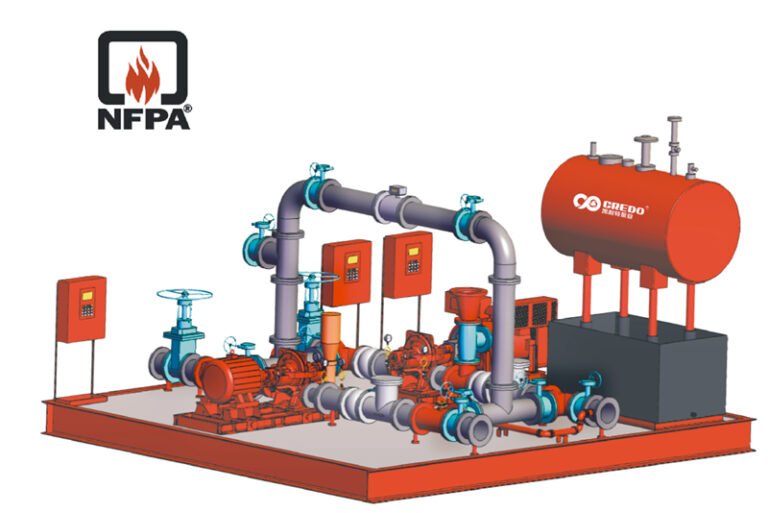
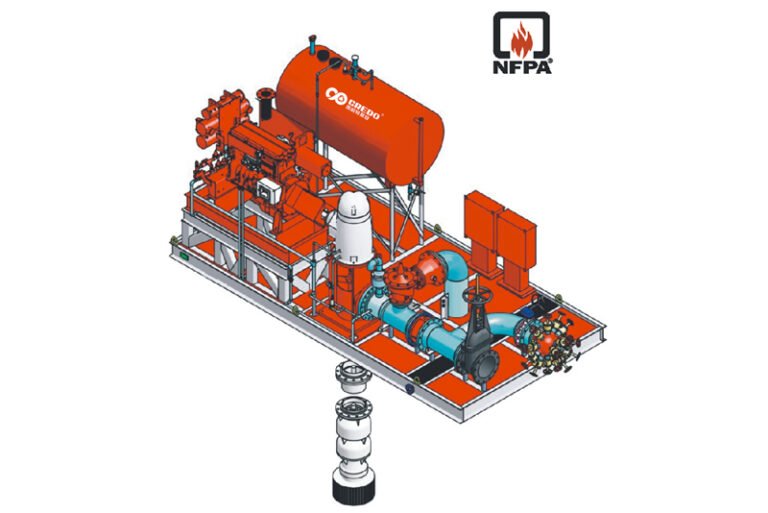
Step 1: Find the flow and pressure you need
The duty point comes from the hydraulic calculation of the sprinkler, hydrant or foam system:
- the largest flow demand, including the hose allowance;
- the pressure needed at the pump, after pipe friction and elevation difference;
- what the water supply already provides, so the pump only has to add the missing pressure.
NFPA 20 then sets the shape of the pump curve. At the rated flow the pump gives the rated pressure. At 150% of rated flow the pressure must not drop below 65% of rated pressure, and at no flow (shut-off) the pressure must not exceed 140% of rated pressure. Standard pump sizes run from 25 to 5000 gpm, so the next size up from the duty point is normally selected.
Step 2: Choose the pump type
| Type | Best for |
|---|---|
| Horizontal split case | Large industrial and commercial buildings, positive suction pressure, easy servicing |
| End suction | Smaller flows, compact installations, back pull-out servicing |
| Vertical turbine | Water below pump level: tanks, reservoirs, wells, rivers. Saves floor space |
| In-line | Mounted on the pipeline where space is tight |
| Jockey pump | Keeps system pressure steady so the main pump does not start unnecessarily |
More detail on each type is on our fire pumps page.
Step 3: Choose the driver
- Electric motor: lower cost, quiet and easy to maintain. Needs a reliable power supply and, where electric pumps are both duty and standby, an automatic transfer switch.
- Diesel engine: keeps running when power fails. Used where supply is weak, where an independent source is required, or for large industrial flows.
- Electric duty plus diesel standby is a common arrangement for high-rise buildings and industrial plants.
Step 4: Controller and jockey pump
The fire pump controller starts the pump automatically on a pressure drop or by hand, and it must be listed for fire pump service. Electric, diesel and jockey controllers are covered on our fire pump controllers page. The jockey pump is sized at about 3% of main pump flow, with a set pressure above the main pump start point.
Step 5: Pump room, valves and test arrangement
- Enough suction supply: tank volume or source that lasts for the design duration.
- Suction and discharge valves, usually OS&Y gate valves, with supervision where required.
- Test header or flow meter loop, so the pump can be tested at its rated flow.
- Pressure relief arrangement where the standard calls for it, and a pump room that is heated, ventilated and drained.
If the pump room is a problem on site, a containerized pump station arrives built and tested.
Approvals and standards
NFPA 20 for installation, UL and FM for listing and approval, and EN 12845 in Europe, together with VdS and LPC where required. The pump, driver and controller should all be listed for fire service. As an example of a large approved pump, the Pumpsense 10HF22 MK1 horizontal split-case pump is FM Approved (Class 1311) at 4500 gpm, see the Pumpsense page or use the PumpSense fire pump selector.
Testing and maintenance
The pump is flow-tested at acceptance. After that, NFPA 25 calls for a regular no-flow (churn) run and an annual flow test at no flow, 100% and 150% of rated flow, to confirm the pump still meets its curve. Batteries, fuel and engine heaters on diesel sets and controller alarms are part of the routine checks.
Our scope
Duty point review, pump and driver selection, controller, jockey pump, skid or containerized packaging, delivery, installation supervision, commissioning, flow testing and maintenance. See the 2500 gpm fire pump packages for ready-made sets.
Frequently asked questions
What is a fire pump?
A fire pump is a dedicated pump that raises water pressure and flow for a fire sprinkler, hydrant or foam system when the supply alone is not enough. It is built, tested and listed for fire service under NFPA 20 and approvals such as UL and FM.
How do I size a fire pump?
Start from the hydraulic calculation of the system: the flow and pressure demand at the pump, including hose allowance, friction and elevation. The pump is then chosen so its curve covers that duty point with a margin. NFPA 20 also fixes the shape of the curve: at 150% of rated flow the pressure must not fall below 65% of rated pressure, and the shut-off pressure must not exceed 140% of rated pressure.
Electric or diesel fire pump?
Electric pumps are cheaper, quieter and need less maintenance, but need a reliable power supply. Diesel pumps run when power fails, so they are used where the supply is weak or where a second, independent source is needed. Many projects use an electric duty pump and a diesel standby pump.
What is a jockey pump?
A small pump that keeps the system pressurised and covers slow losses from small leaks or temperature changes, so the main fire pump does not start unnecessarily. It is typically sized at about 3% of the main pump flow, with a set pressure above the main pump's start pressure.
Do I need a standby fire pump?
It depends on the risk, the standard and the authority: high-rise buildings, industrial plants and high-value sites often need one. Local regulation and the insurer's requirements decide, so confirm with the fire design consultant.
How often should a fire pump be tested?
NFPA 25 calls for a regular no-flow (churn) run and an annual flow test at no flow, 100% and 150% of rated flow, to confirm the pump still meets its curve. A flow test is also done at acceptance.
What is the difference between UL listed and FM approved?
Both are independent approvals of the pump and its components for fire service. UL and FM have their own test and listing schemes. Insurers or the project specification often name one or both, so check which your project needs.