
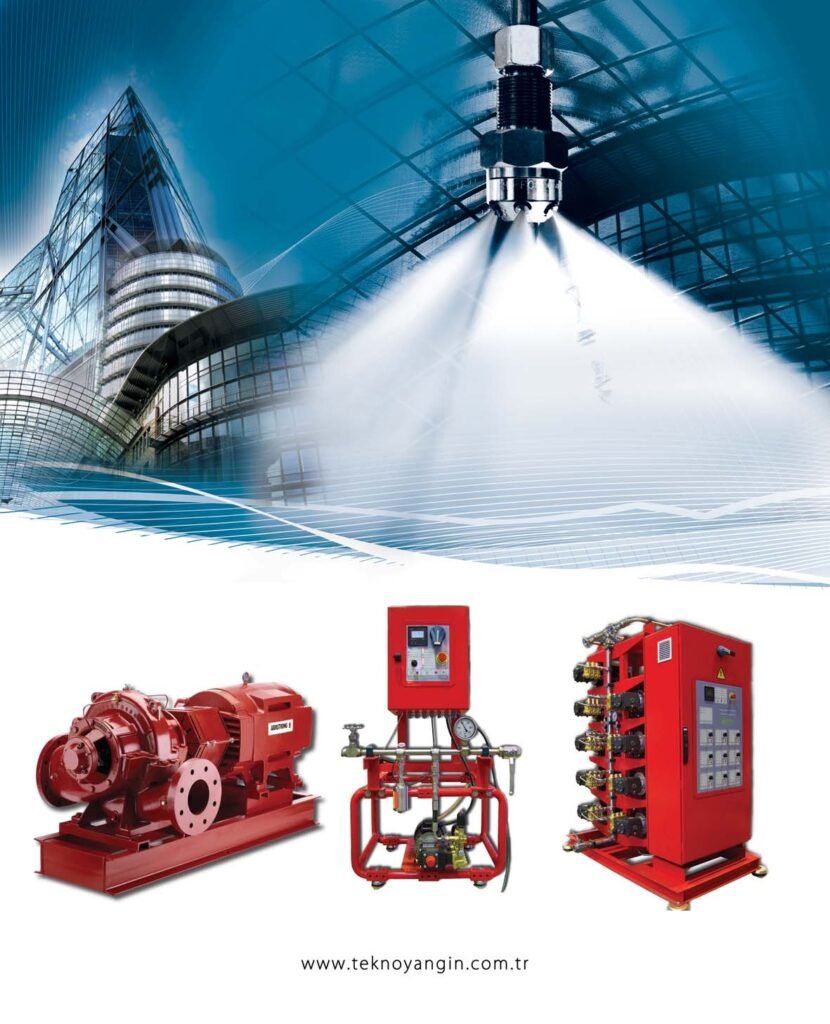
Water mist systems put out or control fires with very fine water droplets. The droplets absorb heat quickly and turn to steam, which cools the fire and displaces oxygen around it. They use much less water than a conventional sprinkler system, which means less water damage, smaller pipes and a smaller water supply. Tekno Yangın designs, supplies and commissions water mist systems for special hazards.
How water mist works
The system atomises water through special nozzles into a mist of fine droplets. Three things happen at once:
- Cooling: the fine droplets have a very large surface area, so they absorb heat from the flames and the hot gases much faster than ordinary sprinkler drops.
- Oxygen displacement: the water turns to steam, which expands and dilutes the oxygen around the fire.
- Radiant heat blocking and pre-wetting: the mist shields nearby surfaces from radiant heat and wets them, which limits spread.
Depending on the hazard, the system can extinguish the fire or hold it in check at an early stage. It is effective on Class A fires, and on Class B or F fires it helps put the fire out and prevent re-ignition.
Advantages
- Effective suppression: steam cools the fire and removes oxygen, reducing heat and the fire's ability to spread.
- Less water damage: much less water is discharged than with sprinklers, so damage to the surrounding area is limited.
- Smaller installation: smaller pipes and a smaller water tank than a sprinkler system, which helps where space or weight is limited.
- Improved safety: can be designed to work at low pressure where high water pressure is not available. The steam can also reduce smoke and improve visibility.
- Wide range of uses: commercial buildings, industrial plants, machinery spaces, ships and heritage buildings, where protecting valuable assets matters.
Classification
Water mist systems are classified by operating pressure, droplet size, agent and design configuration. NFPA 750 defines three pressure classes. The higher the pressure, the finer the mist.
| Class | Operating pressure | Typical droplet size |
|---|---|---|
| Low pressure | Below 175 psi (12 bar) | Below 1,000 microns |
| Intermediate pressure | 175 to 500 psi (12 to 34 bar) | 300 to 500 microns |
| High pressure | Above 500 psi (34 bar) | 50 to 100 microns |
To count as water mist, the droplets must be smaller than 1,000 microns. Conventional sprinkler systems produce droplets of roughly 5,000 microns, for comparison.
System types and water supply
- Pump-driven: an electric or diesel driven pump unit supplies water from a tank at the system pressure.
- Cylinder-driven: a pressurised gas cylinder, typically nitrogen, pushes water from a tank through the nozzles. It needs no electrical supply and suits smaller or remote hazards.
- Zones and valves: total flooding, local application, deluge or pre-action designs, with section valves for zoned protection.
Where it is used
- Machinery spaces, turbine enclosures and generator rooms
- Ships, ferries and offshore installations
- Cable tunnels and cable galleries
- Hotels, hospitals and heritage buildings, where water damage must be limited
- Industrial hazards and special risks in commercial buildings
- Commercial kitchens (Class F hazards)
- Archives and museums
Standards and approvals
Design is to NFPA 750. Systems are approved by fire test for specific hazards, for example to FM 5560, EN 14972, and for marine use IMO MSC.1/Circ.1165. Approval applies only to the hazards and nozzle arrangements tested, so every project needs a hazard assessment and a design that stays inside the approval. We confirm the approvals of the system offered for your project.
Water mist or gas extinguishing?
| Water mist | Gas extinguishing | |
|---|---|---|
| Agent | Fine water droplets | Clean agent, inert gas or CO2 |
| Occupied rooms | Yes, within the approval | Within standard limits (not CO2) |
| Room tightness needed | No, it works in open or partly open spaces | Yes, needs an airtight room |
| Water damage | Small, but not zero | None |
| Best for | Machinery, turbines, tunnels, heritage | Data centres, electrical rooms, archives |
Our scope
Hazard assessment, system selection and design within the approval, hydraulic calculation and drawings, supply, installation, pump or cylinder unit, detection and control, commissioning and maintenance.
Related systems
Frequently asked questions
Is water mist as effective as a sprinkler system?
For the hazards it is approved for, yes, and in some cases it does better, because the fine droplets absorb heat quickly. But approvals are hazard-specific: a water mist system is designed and installed only for the applications covered by its fire test approval, so it is not a drop-in replacement everywhere.
How much water does it use?
Much less than a conventional sprinkler system, which limits water damage and allows smaller pipework and a smaller water supply. The exact figure depends on the hazard and the approved design.
Can water mist be used on electrical equipment?
Some approved systems are listed for energised electrical equipment and for rooms such as turbine enclosures and machinery spaces, but this depends on the approval for that system, so confirm it for your project.
Is it a replacement for gas extinguishing?
It is an alternative where people may be present or where gas discharge is a concern, or where a gas system would need a very tight room. Gas systems still suit sensitive electronics better, so the choice is made per hazard.
What maintenance does it need?
Nozzles have very small orifices, so the water must be clean and filtered, and the piping is usually stainless steel. Regular inspection, flushing, nozzle checks and pump or cylinder checks are part of the maintenance plan.
What drives a water mist system?
Either a pump unit (electric or diesel) or a pressurised gas cylinder, typically nitrogen, which pushes water from a tank through the nozzles.