
Gas extinguishing systems protect rooms and equipment where water, foam or powder would do more damage than the fire: data centres, electrical rooms, archives and similar spaces. The agent fills the whole room, reaches every corner of the protected volume, and leaves no residue to clean up. Tekno Yangın designs, supplies and commissions clean agent, inert gas and CO2 systems to NFPA 2001, EN 15004 / ISO 14520 and NFPA 12.
Types of gas extinguishing systems
Clean chemical agents
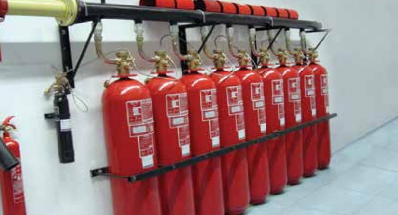
These are stored as liquids in cylinders, pressurised with nitrogen, and turn to gas when discharged. They put the fire out mainly by absorbing heat.
- FK-5-1-12 (Novec 1230): ozone depletion potential 0 and very low global warming potential. Stored at 25, 42 or 50 bar. Short piping runs and a cylinder room close to the hazard.
- HFC-227ea (FM-200): widely installed and well proven. Hydrofluorocarbons are being phased down in some regions, so check local rules for new projects.
- HFC-125 (FE-25): an alternative clean agent for suitable hazards.
Inert gases
Argon, nitrogen and their blends: IG-01 (argon), IG-55 (argon and nitrogen), IG-100 (nitrogen) and IG-541 (nitrogen, argon and CO2). They lower the oxygen level in the room to a level that stops the fire while remaining survivable for a short exposure. They have no ozone or global warming impact, but they are stored as compressed gas at 200 or 300 bar, so they need more cylinders and more space than clean chemical agents, and the room needs pressure relief venting.
CO2
CO2 is effective and economical to refill, but the concentration needed is dangerous to people. It is used only in spaces that are normally unoccupied, such as some machinery spaces, with a pre-discharge alarm and delay, lock-off valves and warning signs. See NFPA 12.
Modular (pre-engineered) systems
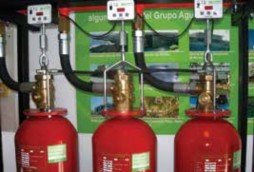
In a modular system the cylinders, release panel, horn strobes, manual release, abort and disconnect switches and detector heads are supplied together on a pre-built frame, so the on-site work is mainly placing the unit and connecting detectors and piping. This suits small and medium rooms, cabinets and projects with short programmes.
| Agent | Typical storage | Occupied rooms | Cylinder space |
|---|---|---|---|
| FK-5-1-12 (Novec 1230) | 25 / 42 / 50 bar liquid | Yes, within standard limits | Low |
| HFC-227ea (FM-200) | 25 / 42 bar liquid | Yes, within standard limits | Low |
| IG-541, IG-55, IG-100, IG-01 | 200 / 300 bar gas | Yes, within standard limits | High |
| CO2 | High pressure liquid | No | Medium |
How a gas system works
- Smoke or heat detectors in two zones (cross-zoned) confirm the fire, which avoids false discharge.
- The release panel sounds the pre-discharge alarm and starts the delay. Ventilation is shut down and dampers close.
- Cylinder valves open and the agent flows through the pipework to the nozzles. Clean agents are discharged in about 10 seconds, inert gases within about 60 seconds.
- The room holds the agent at the design concentration for the hold time, usually 10 minutes, so the fire cannot restart.
- The room is then ventilated safely before anyone goes back in.
System components
- Agent cylinders with valves, manifold and pipework
- Discharge nozzles sized by flow calculation
- Smoke and heat detection, cross-zoned
- Release control panel with manual release, abort and disconnect switches
- Horn strobes and warning signs
- Ventilation and damper shut-down
- Pressure relief venting (inert gas rooms)
- Room integrity (door fan) test and commissioning documents
Where gas extinguishing is used
- Data centres, server rooms and telecom rooms
- UPS and battery rooms
- Electrical, switchgear, transformer and generator rooms
- Control rooms, including airport, metro and plant control rooms
- Archives, libraries, museums and art stores
- Bank vaults and cash handling rooms
- Flammable liquid stores and laboratories
- Cabinets, panels and machine enclosures
- Replacement of old Halon 1301 systems
Standards
NFPA 2001 (clean agent systems), EN 15004 and ISO 14520 (gaseous systems), NFPA 12 (CO2), EN 12094 (components) and NFPA 72 (detection). Approvals such as UL, FM, LPCB and VdS apply to specific products, so we confirm the approvals of the system offered for your project.
Our scope
Hazard survey and agent selection, hydraulic calculation and drawings, supply, installation, detection and release panel, room integrity test, commissioning and handover, and maintenance. We can also integrate the system with your fire alarm panel and building management system.
Related systems
- Water mist systems
- Special extinguishing systems
- Advanced indirect fire suppression system for cabinets and small enclosures
- Fire detection and alarm systems
- Kitchen fire suppression systems
Frequently asked questions
Which gas is best for a data centre?
Both clean chemical agents (FK-5-1-12 / Novec 1230, HFC-227ea / FM-200) and inert gases (IG-541, IG-55, IG-100) are widely used. The choice depends on available cylinder-room space, how far the cylinders are from the room, the environmental targets of the project and local regulations. A design calculation and a site survey settle it.
Is gas extinguishing safe for people?
Clean agents and inert gases are designed to be used in occupied spaces within the limits set by NFPA 2001 and ISO 14520, and every system has a pre-discharge alarm and delay. CO2 is different: the concentration needed is dangerous to life, so CO2 is used only in spaces that are normally unoccupied, with lock-off valves and warning signs.
How long does the discharge take?
For clean chemical agents the standards call for 95% of the design quantity within 10 seconds. Inert gas systems discharge more slowly, typically within 60 seconds.
Does the room have to be airtight?
The room has to hold the agent at the design concentration for the hold time (usually 10 minutes). That is checked with a room integrity (door fan) test, and openings are sealed or closed automatically. Inert gas rooms also need pressure relief venting.
How many cylinders do I need?
It depends on the room volume, the lowest expected temperature, the fuel and the design concentration, so it is found by calculation, not by a rule of thumb. Send us the room dimensions and the hazard and we will size the system.
What maintenance is needed?
Regular inspection of cylinder pressure or weight, valves, detection, the release panel and the alarms, and a periodic room integrity test. Cylinders also need periodic pressure testing under the applicable cylinder rules.